
preprint · series opening
God’s Infinite Dimensional Space
Transcendental Embeddings as a Way to Mathematically Express Reality, Predictive Observer-State, and the Next Phenomenal Transition of Observers
“Und mich ergreift ein längst entwöhntes Sehnen
Nach jenem stillen, ernsten Geisterreich,
Es schwebet nun, in unbestimmten Tönen,
…
Was ich besitze seh’ ich wie im weiten,
Und was verschwand wird mir zu Wirklichkeiten.”
“What I possess, I see as if far away;
I yearn for what lies beyond, for infinite space.”
Faust: Part One, Act I · Loosely translated
How does reality appear to you?
Reality is too large to be experienced all at once, so organisms inherit a finite way of carving it up. A person then becomes a specific realized version of that inherited structure through language, history, memory, culture, and repeated events. For prediction, I do not need the whole ‘soul’ in some mystical sense, I just need a task-relevant approximation of the person: a slow representation of what they are generally like now, a fast representation of what is currently active in them, their present role and world-state, and a representation of the ‘proposition’ hitting them now. Then I model the interaction, predict the next task-relevant state (for the observer), decode visible outcomes from it, and update the system under error. The categorical part matters because a lot of what we observe about people is discrete, repeated, and role-dependent.
You can model your current mental interior, everything that you are experiencing now, as a small slice of reality that your genetic lineage allows you to experience, that can be traced by a series of state transitions up until this moment in time. The mind is an evolved, structured projection system that turns input into a lived state, and behavior is downstream of transitions in that state. Predicting what your next state will be is not an impossible task: in this work I am attempting to formalize a standard algebra to make this easier and tractable.
I’ll be blunt, this work is a monster, and it is, in essence, autobiographic of the mental state of the author who wrote it, representing the debauched & tortured way in which these ‘discoveries’ were made:
-As philosophy: this work is ambitious but undisciplined.
-As math: this work is mostly formal packaging around these undisciplined assumptions.
-As ML research propositions: this work is potentially worthwhile if you squint at it.
-As a finished research article: I fear it cannot be completed with a lifetime of work.
However, the goal is to examine this:
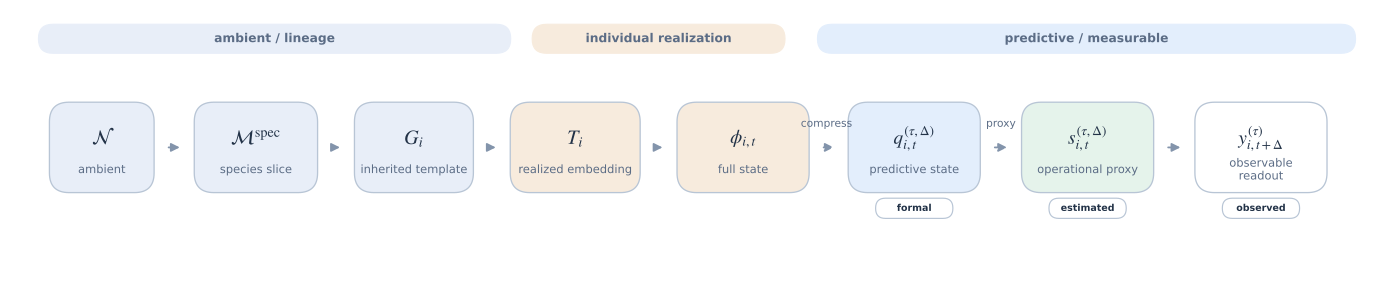
skip to the end if you are impatient and want a definition now
If you believe my axioms, you can apply this framework to your own projects and start predicting the next phenomenal state of ‘agent observers’ (people); if you do not believe my assumptions this paper will be useless to you (but I swear to entertain, nonetheless).
Almost every serious attempt to formalize mind or behavior ends up either:
Waiting on neuroscience: “once we map the ‘connectome’ (or whatever the new limitation is) we’ll understand behavior,” which has been 20 years away for 50 years
Staying purely behavioral: black box input/output with no theory/framework of internal structure
Getting lost in phenomenology: Husserl, Heidegger, etc. philosophical but computationally intractable, thus mostly pointless.
This paper attempts a fourth path: take the structure of experience seriously as a mathematical object without needing to know its physical underpinnings. The brain is completely irrelevant to the formalism. You could run the same framework on an octopus, a corporation, or a hypothetical silicon agent and the algebra doesn’t change, only the dimensionality of the embedding and the content of the axes.
The closest intellectual ancestors are probably:
Friston’s free energy principle (I legitimately didn’t read this guy until well after part 2 was written, avoiding this line of thinking earlier would have been great): similar ambition of substrate-independence, but Friston goes deep into neuroscience anyway and the math becomes almost deliberately obscure, we cannot do engineering off of his concept.
Marr’s levels of analysis: the idea that computational and algorithmic descriptions are valid independently of implementation
Early Dennett: intentional stance as a legitimate predictive state without committing to substrate
But this paper is more engineering-forward than any of those. It’s not asking “what is mind,” which at this point is a stupid question to ask, instead we ask: “assuming mind has structure, what’s the minimal formal system that lets us predict its next state from observations alone.”
This paper aims to formalize several disparate fields into a single, coherent whole. We’ll begin with the tragic story for this exploration (which has to do with Kant), then go down the rabbit hole of theory together and come out the other side with a fundamental theory of ‘reality’ that can be applied across some fields. First, we’ll discuss how the appearance of reality is constructed and how organisms parse out their version of reality. Next comes how organisms perceive state (state being the appearance of reality at that instant), and what the organism is biased to do next. Afterwards, we’ll discuss how to compute memory and learning, and apply this to our understanding of state and decompose the philosophical proposition into a register that can be understood by engineers. Once fully understood, you’ll be able to eventually program/understand an individual’s psychology with precision for the task you are interested in discovering.
There is a universal way to decompose all of these questions into a single mathematical space, and I will illustrate that here. Let us take the measure of reality and examine God’s infinite dimensional space!
Lastly, here are the diffences between GIDS and standard ML:
Standard ML: construct a model → optimize for task performance → latent representations are a byproduct. GIDS: construct a stable latent object over the observer → task performance is a probe that tells you if your latent object is good → the ontology is the product.
The dominant paradigm right now is:
-Collect massive undifferentiated data -Train a general model on reconstruction or next-token prediction -Hope that task-relevant structure emerges in the latent space -Fine-tune or probe for specific applications afterward
This is the GPT/BERT/foundation model playbook. It works extraordinarily well for language and increasingly for vision. But it treats the latent space as a consequence of scale rather than a design target.
GIDS inverts this completely and deliberately. The latent space is the goal, this is the product we will define, the inputs and outputs are just discovery probes. Scale is just a mechanism to get there; GIDS is a research program on how to bootstrap itself.
Preface
First, we’re going to talk about Kant (German philosopher, hugely important), don’t worry about the exact details of his works, I’m just going over the first handful of sections in his main book, Critique of Pure Reason, and using that as a jumping off point to how your reality can be represented using embeddings and states. Next, we’ll use the embedding concept to examine and measure bias when an individual is interpreting reality. And finally, we’ll talk about applications using this technique. Apologies for using philosophy as a segway into math; however, the pill is easier to swallow if the source of all this is adequately explained. I’ve kept the terms restricted to what you can find in a modern dictionary, so don’t worry about converting from some esoteric nonsense to English.
I read Kant directly while going through the Western canon. Unfortunately, Kant is the worst person to represent his own ideas, so you’ll have to bear with my fundamental misunderstanding of the source material. This is good news, however, as my misunderstanding of Kant is more useful than getting a ‘correct’ interpretation from most commentators. If you want to save yourself a year of your life, you can skip The Critique – and ignore all of the requisite readings – and try Wolff’s class (Link). Kant uses a lot of dated terminology and systems that are only relevant to the era he wrote in (a reason why you should always start with the Greeks). I forgot exactly why, but if you’re going to read it, read the first edition, not the second. Also, just skip Kant’s stupid moral system and the categorical imperative altogether. The Critique of Pure Reason rips itself to shreds: Nietzsche was right, Kant became a coward before his God.
Table of Context:
Part 0: Background:
“Kant From An Evolutionary Perspective”
“A Fucking Table”
Part 1: Specifying the Area of Interest:
“Vectors Are All You Need”
“The Nature of Phenomenal Reality: What are we trying to measure?”
“The Evolutionary Mechanism for Encoding Transcendental Embeddings”
Part 2: Deriving the Transcendental Embedding:
“The Technical Scope (because otherwise I’ll accidentally lie to you)”
“Behold; You! The Chimera”
“The Notion of State”
“Observable Predictive State”
“Memory as a Series of Vectors”
“Minimality, Identifiability, and Slow/Fast Factorization”
“Deriving the Transcendental Embedding”
Part 3: Application — Predicting How People Behave:
“Towards a Universal State Transition Function”
“God’s Infinite Dimensional Space: Making All Realities Composable”
“Creating the World Model”
“From Forecasting to Proposition Search”
Part 4: Benchmarking the World Model:
“Operational Definition of State”
“Dataset Construction”
“The Benchmark”
“The Proposed Latent-State Model”
“Training Objective, Update Loop, and Intervention”
“Temporal Split, Evaluation, and Drift”
Part 5: Axioms, Lemmas, and Main Theorem:
“Proof Boundary”
“Sufficiency and Minimality”
“Minimal-State Uniqueness”
“History Mediation by the Fast State”
“Observational Proposition Ranking”
Background
The Kant background, the evolutionary framing, and the critique that motivates the rest of the manuscript.
Specifying the Area of Interest
The vector-space framing, the toy phenomenal transition, and the formal species-level projection setup.
Deriving the Transcendental Embedding
The technical scope, state construction, categorical trace pooling, and the slow/fast factorization.
Application
The transition function, the composable world model, and the move from forecasting into proposition search.
Benchmarking the World Model
Operational state definitions, dataset construction, latent-state model details, and temporal evaluation rules.
Axioms, Lemmas, and Main Theorem
The proof boundary, formal statements, and the theoretical claims the framework is actually asserting.
Study Guide / Cheat Sheet
A study guide, operational checklist, toy example, and quick-reference version of the paper's machinery.